
Archives
-
THE ROLE OF SOCIAL MEDIA IN MALAYSIAN HIGHER EDUCATION: A CONCEPTUAL FRAMEWORK FOR ENGAGEMENT, VISIBILITY, AND GOVERNANCE
Vol. 4 No. 4 (2026)Social media has emerged as a transformative force in higher education, particularly within Malaysia's rapidly evolving digital academic landscape. This paper presents a conceptual framework that examines the role of social media across three key domains: student engagement, institutional visibility, and governance. Focusing on the Malaysian context, the study explores how both public and private higher education institutions leverage platforms such as Instagram, TikTok, Facebook, YouTube, and WhatsApp to enhance student engagement, strengthen institutional branding, and improve policy responsiveness. The study argues that social media provides a unique opportunity for institutions to foster inclusive and interactive learning environments while also navigating the complexities of digital governance. Methodologically, it synthesizes desk research, institutional practices, and the evolving regulatory landscape to map the opportunities and challenges associated with social media use in higher education. The findings aim to provide valuable insights for institutional leaders, academics, and policymakers, offering strategies to harness social media effectively for quality-driven and impactful higher education delivery in the digital age.
-
Accelerating Research Commercialization: How Digital Tools Drive Collaboration and Knowledge Sharing
Vol. 1 No. 1 (2026)In the context of accelerating research commercialization, digital tools have emerged as essential enablers of collaboration, communication, and knowledge sharing for start-ups and spin-offs. This study aims to investigates how digital tools support research commercialization in start-ups and spin-offs, particularly within Asia's higher education-linked innovation ecosystems, addressing the underexplored concrete impact of these tools despite their widespread adoption. The objective is to understand how digital collaboration infrastructures influence the pathways, performance, and scalability of commercialization efforts and to generate empirically grounded insights into their strategic value. A quantitative exploratory design was adopted, utilizing a structured survey administered via Google Forms to 56 participants across Malaysia, Indonesia, Thailand, India, Sri Lanka, Bangladesh, Pakistan, and the Philippines. Data analysis involved descriptive statistics and visual analytics. Findings indicate high adoption rates of digital tools, with 71.4% of participants regularly using at least two tools, and video conferencing being universally adopted (100%). Real-time document editing and sharing was the most valued feature (85.7%). However, significant challenges include software or license restrictions (71.4%), difficulty connecting with investors or partners online (71.4%), and difficulty tracking progress or lack of training (71.4%). The study concludes that while digital platforms are central to contemporary commercialization efforts, facilitating communication, collaboration, and knowledge management, their effectiveness is influenced by contextual factors such as regulatory complexity, digital literacy, and infrastructural access, limiting their contribution to later-stage activities like investor engagement and legal compliance.
-
Exploring the Effect of Internet Banking Service Quality on Customer Satisfaction and Loyalty Among College Students
Vol. 3 No. 3 (2026)The fintech sector consistently demonstrates potential based on the number of users and its market penetration. This demands that existing players consistently strive for customer satisfaction and loyalty. Within this sector, higher education institutions have adopted internet banking to ensure efficiency, accessibility, and transparency in transactions. Consequently, the researcher conducted a study focusing on college students in a higher education institution to understand their e-satisfaction and e-loyalty regarding internet banking. Through a self-administered questionnaire, the researcher surveyed 227 undergraduate students using internet banking services. The results indicate that respondents view the e-SERVQUAL dimensions of internet banking positively, with efficiency, user-friendliness, and site organization receiving the highest ratings. The respondents also showed high levels of e-customer satisfaction and e-customer loyalty. Using PLS-SEM, it was found that among the modified e-SERVQUAL dimensions, user-friendliness, personal needs, and efficiency significantly impact e-customer satisfaction. The dimensions of e-SERVQUAL accounted for 63.5% of the variance in e-customer satisfaction. Additionally, e-customer satisfaction significantly and positively influences e-customer loyalty, explaining 57.9% of the variance in e-customer loyalty. This research also highlights practical implications for enhancing college students' e-satisfaction and e-loyalty towards internet banking services by focusing on these significant factors.
-
The Effectiveness of Experiential Learning on Academic Performance in Higher Education.
Vol. 5 No. 5 (5)While contemporary higher education is shifting towards active pedagogical strategies, a scarcity of empirical research exists that quantifies the impact of experiential learning on academic performance, particularly within the Cambodian context. This study addresses this gap by examining the relationship between the four dimensions of Kolb's Experiential Learning Theory-Concrete Experience (CE), Reflective Observation (RO), Abstract Conceptualization (AC), and Active Experimentation (AE)—and student achievement at BELTEI International University. Employing a quantitative survey design, data were collected from 385 undergraduate students. To ensure statistical validity, the analysis was conducted using a Generalized Linear Model with a first-order autoregressive correction. The results demonstrated that the experiential learning framework is a powerful predictor, explaining 73.8% of the variance in academic performance. Specifically, Active Experimentation (AE), Reflective Observation (RO), and Abstract Conceptualization (AC) emerged as highly significant predictors, with AE being the most influential. Conversely, Concrete Experience (CE) was not a significant unique predictor in the final model. These findings provide robust quantitative evidence for higher education institutions to prioritize and integrate learning strategies that foster active, reflective, and conceptual engagement to enhance student success.
-
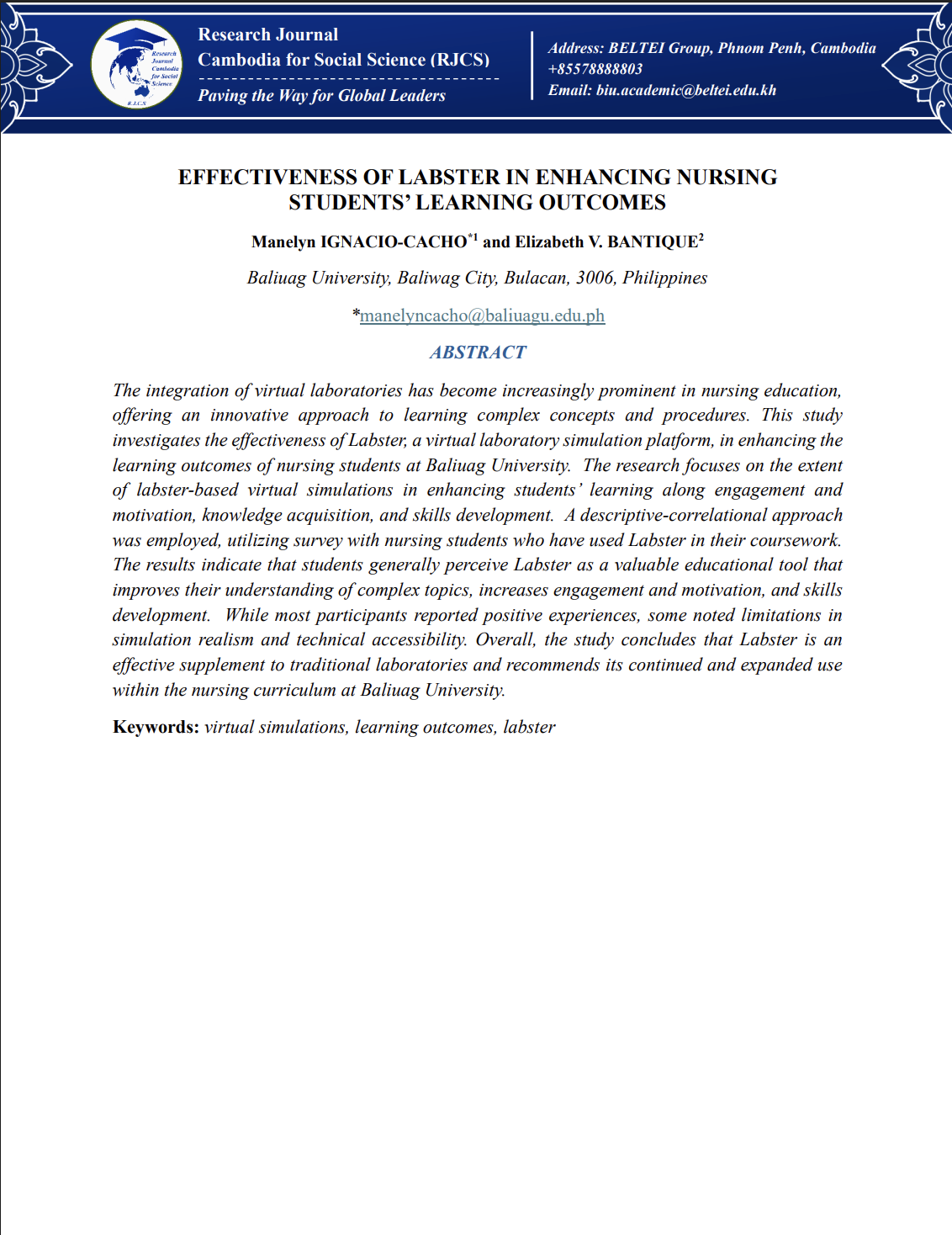
EFFECTIVENESS OF LABSTER IN ENHANCING NURSING STUDENTS' LEARNING OUTCOMES
Vol. 2 No. 2 (2026)The integration of virtual laboratories has become increasingly prominent in nursing education, offering an innovative approach to learning complex concepts and procedures. This study investigates the effectiveness of Labster, a virtual laboratory simulation platform, in enhancing the learning outcomes of nursing students at Baliuag University. The research focuses on the extent of labster-based virtual simulations in enhancing students' learning along engagement and motivation, knowledge acquisition, and skills development. A descriptive-correlational approach was employed, utilizing survey with nursing students who have used Labster in their coursework. The results indicate that students generally perceive Labster as a valuable educational tool that improves their understanding of complex topics, increases engagement and motivation, and skills development. While most participants reported positive experiences, some noted limitations in simulation realism and technical accessibility. Overall, the study concludes that Labster is an effective supplement to traditional laboratories and recommends its continued and expanded use within the nursing curriculum at Baliuag University.