About the Journal
Current Issue
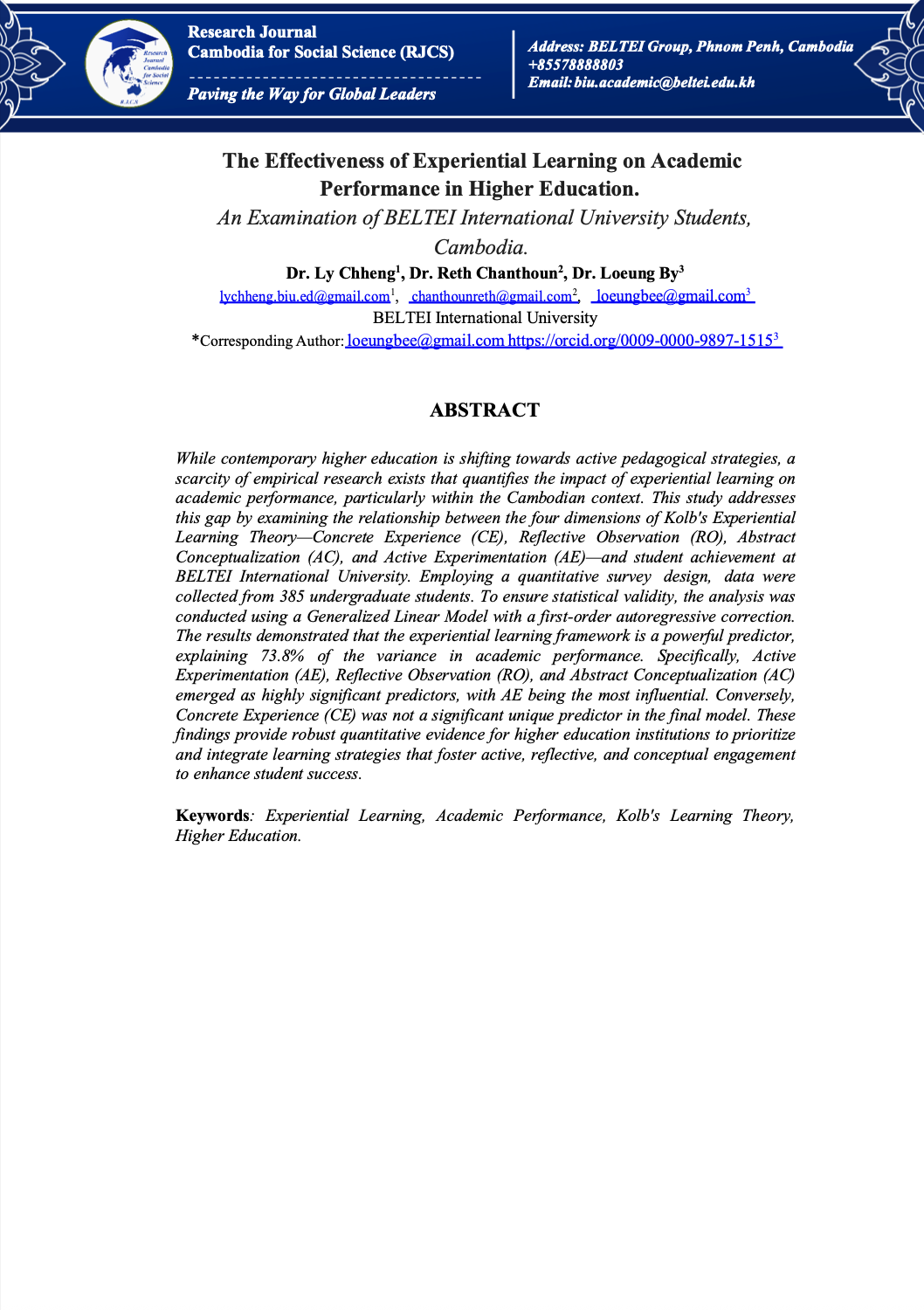
While contemporary higher education is shifting towards active pedagogical strategies, a scarcity of empirical research exists that quantifies the impact of experiential learning on academic performance, particularly within the Cambodian context. This study addresses this gap by examining the relationship between the four dimensions of Kolb's Experiential Learning Theory-Concrete Experience (CE), Reflective Observation (RO), Abstract Conceptualization (AC), and Active Experimentation (AE)—and student achievement at BELTEI International University. Employing a quantitative survey design, data were collected from 385 undergraduate students. To ensure statistical validity, the analysis was conducted using a Generalized Linear Model with a first-order autoregressive correction. The results demonstrated that the experiential learning framework is a powerful predictor, explaining 73.8% of the variance in academic performance. Specifically, Active Experimentation (AE), Reflective Observation (RO), and Abstract Conceptualization (AC) emerged as highly significant predictors, with AE being the most influential. Conversely, Concrete Experience (CE) was not a significant unique predictor in the final model. These findings provide robust quantitative evidence for higher education institutions to prioritize and integrate learning strategies that foster active, reflective, and conceptual engagement to enhance student success.